Persian Brides by Dorit Rabinyan
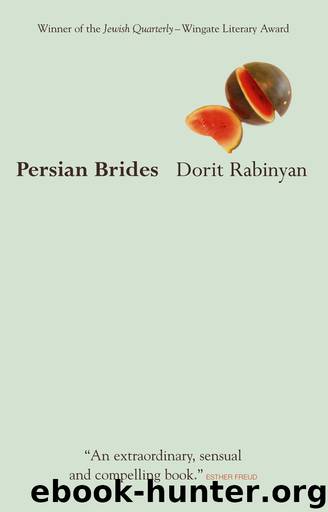
Author:Dorit Rabinyan [Rabinyan, Dorit]
Language: eng
Format: epub
ISBN: 9781782112990
Publisher: Canongate Books
11
When Nazie was five years old and weighed fifteen kilos – about as much as the meat that Omerijan housewives bought for a big festive dinner – her parents died of food poisoning, and her father’s twin brother persuaded Miriam Hanoum to take in the orphan girl. She addressed her aunt as ameh bozorg, great-aunt, but she called her uncle Daddy, because his face was one with her father’s. She missed her mother dreadfully. Whenever Miriam Hanoum’s husband saw Nazie’s triangular face looking sad, he would take hold of her sharp chin and shake it lovingly until she smiled, then he pinched it, as though trying to pull off the tip of the inverted triangle. Finally abandoning the chin, he would kiss his fingertips loudly.
When Nazie was six, Flora said to her: ‘Go away, this is not your house, this is not your mama, this is not your daddy, go away!’ Moussa in his rough boy’s voice told his sister to shut up.
In the year of the great drought, when Nazie was seven and did not yet know that she was intended for Moussa’s bed, he sneaked one morning into the emptying coop of the Moslem chicken-breeder and stole a solitary egg, which glowed at him like a whitish oval sun. That year all the cisterns failed, the lakes dried up, and the fish-ponds vanished. On the bottom of the channels surrounding the village, under the broiling sun, twinkled silver coins which had fallen over the years from the hands of children. Even the brackish pools in the valleys turned into dazzling white salt-pans, driving the thirsty and hungry people to despair.
At that time quite a few rogues were found out who converted in turn to Christianity, Islam and Judaism so as to receive food, clothing and money, and having run out of religions ended up wandering hungrily through the alleys. Many of the region’s villagers migrated that year to Shahrud and Babol, hoping to find some employment in the silk industry, but this too failed when the silkworms died, and the mills were reduced to weaving cotton and linen.
In that year of famine the demons of Omerijan did not pamper the village housewives with double and triple yolks in the hens’ eggs. Most of the hens perished of hunger and thirst, their combs having turned blue from desperate clucking for water. The few eggs which reached the village stalls were imported from overseas, like huge pearls nestling in cotton waste. The merchants sold them to the fishermen, who sold them to itinerant pedlars, and by the time they reached the poultry stalls in Omerijan they were mostly rotten or cracked, and cost as much as a young chicken in a year of plenty. Only the wealthy were able to celebrate the annual No Ruz, the traditional Zoroastrian rite marking the day when the bull which bears the world on its head transfers its weight from horn to horn. A mirror was placed in the middle of the cloth spread on the carpet, and on it as many eggs as there were people present.
Download
This site does not store any files on its server. We only index and link to content provided by other sites. Please contact the content providers to delete copyright contents if any and email us, we'll remove relevant links or contents immediately.
In Control (The City Series) by Crystal Serowka(36192)
The Wolf Sea (The Oathsworn Series, Book 2) by Low Robert(35202)
We Ride Upon Sticks by Quan Barry(34491)
Crowbone (The Oathsworn Series, Book 5) by Low Robert(33583)
The Book of Dreams (Saxon Series) by Severin Tim(33343)
The Daughters of Foxcote Manor by Eve Chase(23573)
Trainspotting by Irvine Welsh(21588)
Call Me by Your Name by André Aciman(20453)
The Secret History by Donna Tartt(18977)
Shot Through The Heart (Supernature Book 1) by Edwin James(18892)
All the Missing Girls by Megan Miranda(15829)
The Girl from the Opera House by Nancy Carson(15755)
American King (New Camelot #3) by Sierra Simone(15691)
Pimp by Iceberg Slim(14449)
Sad Girls by Lang Leav(14374)
The Betrayed by Graham Heather(12792)
The Betrayed by David Hosp(12742)
4 3 2 1: A Novel by Paul Auster(12344)
Still Me by Jojo Moyes(11232)
